
Tuhan adalah yang paling jelas; Maha Dahir dan Maha Cahaya. Tetapi Tuhan adalah yang paling tersembunyi; Maha Batin dan Maha Akhir. Bagaimana kita bisa memahami konsep Ketuhanan? Bagaimana kita bisa tergetar oleh hadirnya Tuhan? Bagaimana kita bisa melihat ke mana pun hanya ada wajah Tuhan?
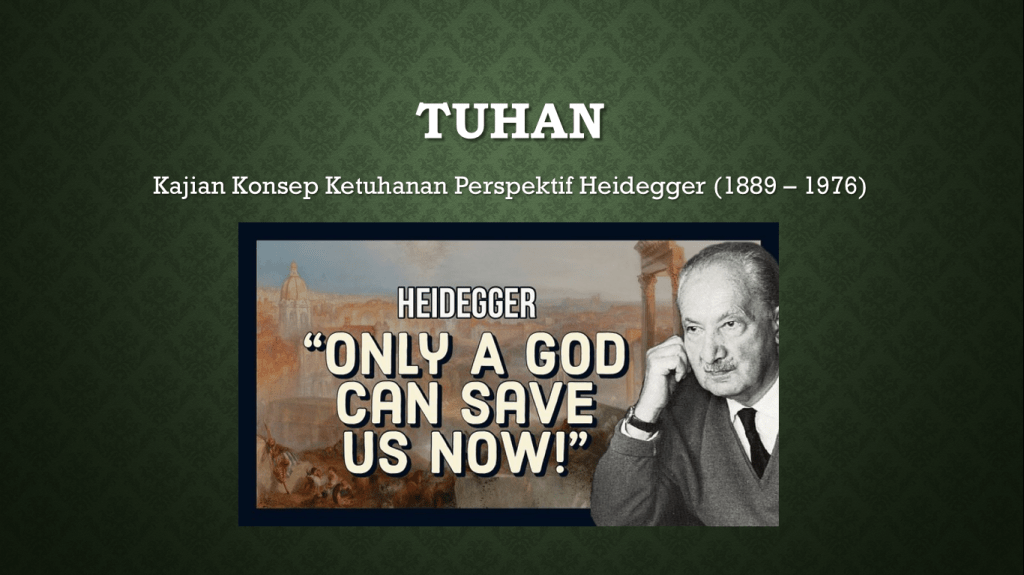
Dalam tulisan ini, kita akan membahas konsep Tuhan dari perspektif Heidegger (1889 – 1976): sejarah; etika; dan ontologi. Pertama, kita melihat bagaimana Heidegger mengembangkan konsep Tuhan sepanjang sejarah hidupnya. Kedua, untuk memahami konsep Tuhan kita perlu etika berpikir terbuka; tidak cukup logika formal saja; kita butuh sikap ikhlas. Ketiga, setelah membahas bagian pertama dan kedua, baru kita masuk pembahasan Tuhan secara ontologis.
1. Sejarah Tuhan
2. Etika
3. Ontologi Tuhan
4. Diskusi
5. Analisis Akhir
“Hanya Tuhan yang bisa selamatkan kita.” Heidegger tua terkenal dengan ucapannya, “Only a God can save us.” Situasi alam raya, saat ini, dalam bahaya. Bom atom meledak dengan korban jutaan jiwa di Nagasaki Hiroshima pada tahun 1945. Ledakan teknologi AI lebih berbahaya dari bom atom terjadi akhir-akhir ini. Bagaimana kita bisa menghadapi itu semua? “Hanya Tuhan yang bisa selamatkan kita.”
1. Sejarah Tuhan
Pada masa muda, Heidegger mengkaji Tuhan dari perspektif teologi. Pada masa tua, Heidegger mengkaji dari aspek filosofi dan “berpikir.”
Pada tahun 1903, Heidegger mulai berlatih untuk menjadi pendeta. Ia masuk seminari Jesuit pada tahun 1909, tetapi keluar dalam beberapa minggu karena masalah jantung. Pada masa inilah ia pertama kali menemukan karya Franz Brentano. Dari sana ia melanjutkan studi teologi dan filsafat skolastik di Universitas Freiburg. (Ia lahir 1889).
2. Etika
Konsep Tuhan berbeda dengan konsep matematika; misal 2 + 1 = 3 pada bilangan asli. Anak yang sudah paham 2 + 1 adalah 3 maka tidak diperlukan hal lain, dia akan selalu paham 2 + 1 = 3. Sedangkan untuk memahami Tuhan, kita membutuhkan etika yaitu sikap ikhlas dan berpikir terbuka. Hati kita butuh tergetar resonansi bersama Tuhan.
Heidegger selanjutnya menganalisis bahwa hubungan resonansi awal ini hancur dalam proses objektifikasi aktivitas penelitian. Dalam sikap penelitian, “aku” tidak lagi beresonansi dan bergema. Dengan demikian, dunia tidak lagi menjadi dunia. “Aku” menghilang dan dunia secara bertahap menjadi “objek”. Dunia sebagai objek tidak lagi “menyentuh” (Berührt) aku.
3. Ontologi Tuhan
Bagian paling sulit adalah ontologi Tuhan. Untuk memahami ontologi, kita perlu pertolongan Tuhan. Hanya ketika Tuhan melimpahkan cahaya maka manusia bisa melihat terang cahaya. Dari sisi manusia, kita perlu berjuang dengan ikhlas untuk bersiap menerima pancaran cahaya.
Pengungkapan keberadaan (wujud) dari enowning merupakan proses yang dijelaskan Heidegger dalam Contributions sebagai essential swaying (Seyn west). Penting untuk diingat bahwa ia menggunakan kata kerja.
4. Diskusi
Bagaimana menurut Anda?
Mindfulness
Berikut adalah catatan saya; bersumber dari buku Mindfulness karya Heidegger 1938-1939. Manusia butuh keteguhan pengetahuan-kesadaran untuk membahas tema Tuhan; tidak cukup definisi, hitungan, ilustrasi, mau pun teknologi.
[A. Keteguhan Pengetahuan Kesadaran; B. Tiga Posibilitas Eksistensi; C. Teknologi Sejarah; D. Tuhan Seiring Laku; E. Berani Terpesona;
F. Manusia Terpisah; G. Batas Penyucian; H. Berjumpa Tuhan; I. Pasti Laku; J. Awal Baru;
K. Salah Jalan; L. Jembatan Ruang-Waktu; M. Resonansi Kreatif; N. Bukan Ateis; O. Paling Benar;
P. Tak Bisa Dihitung; Q. Terdalam; R. Lompatan; S. Maha Akhir. ]
A. Keteguhan Pengetahuan Kesadaran
Tidak cukup mengandalkan kepastian atau niscaya. Kepastian hanya diperlukan oleh orang yang tidak tahu; yang ingin prasangka mereka dikonfirmasi secara pasti. Kepastian prasangka ini ada di luar pengetahuan-kesadadaran. Kita butuh keteguhan dalam pengetahuan-kesadaran.
“Thinking gods and speaking of them already requires inabiding a fundamental knowing-awareness. This thinking and this speaking do not require certainty which, as such, lies outside the fundamental claims of fundamental knowing-awareness. For, every certainty is always only the additionally reckonable warranty in accord with which the ‘not-knower’ at first consents to accept “knowing” and its advocacy.” (Mindfulness, 203)
B. Tiga Posibilitas Eksistensi
Untuk membahas wujud (being atau eksistensi), kita perlu mempertimbangkan 3 kemungkinan: [1] wujud mandiri; [2] wujud saling relasi; [3] wujud tersembunyi meski saling relasi.
[1] whether in laying claim on being, beings once again are grounded inceptually and appear in the simpleness of their ownmost.
[2] whether beings hold on to the chains and conventionalities of the hitherto historically mixed up and inextricable beingness and compel to a total lack of decision;
[3] whether the first possibility stays away, and though the second one does assert itself, and given their admitted appearance, beings dominate all being but still something else happens: whether the history of be-ing (the grounding of its truth) begins in the unknowable hiddenness-shelteredness within the course of the struggle of the ‘alone ones’ and whether be-ing enters its ownmost and strangest history whose jubilation and sorrow, triumphs and defeats beat only in the sphere of the heart of the most rare ones.” (Mindfulness, 203 – 205)
C. Teknologi Sejarah
Sayang sekali: sejarah menjadi teknologi yang memproduksi representasi masa lalu dan masa kini. Sedangkan, sangat disayangkan juga, teknologi menciptakan sejarah dengan eksploitasi alam.
“‘History’ as the technicity of representing the past and the present, and technicity as producing the ‘history’ of exploitation of nature, are therefore both unified procedures through which and increasingly without exception the individual man always eliminates every inquiry into the ‘whereunto’ and the ‘why’ as aberrant and superfluous. ‘History’ tolerates and puts up with itself still only as the exploration of what in advance is taken to be self-evident.
Seen from the Occidental point of view, the commonsensicality of democracies and the rational plannability of “absolute authority” will one day find and recognize each other as the same.” (Mindfulness, 207)
D. Tuhan Seiring Laku
Tuhan bukanlah obyek-penderita untuk diamati manusia; atau bukan pula obyek dari kegiatan manusia. Tuhan, atau nama-nama Tuhan, hadir seiring kebenaran “laku” manusia. Bagaimana pun, manusia tidak bisa memaksa Tuhan meski Tuhan melimpahkan kebebasan kepada manusia.
“God is never a being about which man knows something at times this way and at times another way; god is never a being whom man gets closer to in varying distances. Rather, gods and their godhood arise [G236] from out of the truth of be-ing, which is to say that, for instance, the thingly representation of god and the explanatory reckoning with god as the creator are grounded in the interpretation of beingness as produced and producible presence.
But man can neither steer nor force the manner in which, at any given time, be-ing enowns its truth or holds it back in order to leave beings entirely to themselves and to their raving in machination, because according to the belongingness to be-ing that is fundamental to man and without fathoming this history and having an inkling of it, he is attuned by be-ing to determine his ownmost.
And yet it depends entirely on the freedom of man, on how and to what extent he transforms and grounds that attunement into his destiny – an attunement which comes upon him from be-ing – and so at any given time shapes his ownmost into a definite gestalt.” (Mindfulness, 209)
E. Berani Terpesona
Hanya ketika manusia berani terpesona dalam nama Tuhan maka manusia berpotensi resonansi mengenal Tuhan.
“Hence all naming and reticence of gods resonates in the mindfulness of the history of be-ing. And only when the venturesome ones of man let themselves be attuned to the tempest of this history; only when the dismay that sets-free is no longer misinterpreted psychologically and morally, but instead re-grounded on a path of inabiding Da-sein (as awaiting the clearing of refusal), only then is a footpath stepped onto, which leads to the regions for preparing man for grounding a different ownmost to his own self and which allows a quiet intimation to arise that the flight and nearness of gods once again may lead to a decision. Every other way – that of calculating beings, explaining and obfuscating them – is only seemingly a pathway. Godlessness does not consist in the denial and loss of a god, but in the groundlessness of the [G238] godhood of gods. Therefore, the pursuit of customary worship and its consolations and uplifting can all the time be godlessness; equally godless is the replacement of such worship by enticing “lived-experiences” or paroxysms of emotion.” (Mindfulness, 210)
F. Manusia Terpisah
Sudah terlalu lama manusia tidak berani terpesona oleh nama Tuhan. Mereka terjebak dalam kesibukan siang dan malam. Manusia menjauh dari Tuhan.
Since long ago man is without attunement. Without their night and without their day, gods flee from the swaylessness of their godhood. But man still relies on his opinions and achievements and on their desolateness he pastes the images of his confused flickering “lived-experiences”.
And nevertheless already a hinting comes to pass; nevertheless the dismay that sets-free strikes into the machination of beings, and nevertheless another history has already begun, which perhaps the man hitherto will in the long run never experience because he puts his trust into his hithertoness, which, given the growing upheavals and alterations of his undertakings, he has only seemingly left behind. (Mindfulness, 211)
G. Batas Penyucian
Upaya ritual penyucian telah gagal mengantar manusia mengenal nama Tuhan. Ateisme sama gagalnya.
In the preparation for the godhood of gods through divinization and through de-godding there rules a unique belongingness of man to be-ing, which is best characterized with the words forgottenness of be-ing. This forgottenness gives preeminence to beings themselves as “the most actual”, and marks them as representable and producible. To the extent that representation and production reach their limits, which they grasp right away as the limits of beings, and insofar as the explainable comes upon the un-explainable, the explainable must either be glorified or explained with the help of the un-explainable itself.
In each case representation arrives at a higher being or at a being that is beyond beings [Uber-seiende]. Here the godhood of gods never arises out of the swaying of be-ing. Indeed, gods who arise out of divinization lack godhood altogether. (Mindfulness, 212-213)
H. Berjumpa Tuhan
Manusia membuka pintu perjumpaan dengan Tuhan dengan laku sejati; Tuhan bebas menganugerahi kunci.
That be-ing is -this most hidden hearth-glow inflames history as be-ing’s struggle for the countering of gods and man- a struggle which only struggles for the ownmost swaying of be-ing out of be-ing itself, and thus rekindles the glowing of its glow unto the most sheltered-concealed stillness. Gods are those who necessitate Da-sein, that is, the guardianship of man, but in such a way that gods’ distressing need, the need of their own godhood, arises out of be-ing as enowning. (Mindfulness, 214)
“Nama-Nama Tuhan yang meniscayakan Dasein, yaitu, penjagaan manusia, tapi dengan jalan kehendak kuat Tuhan, kehendak ilahi, hadir dari be-ing as enowning.”
I. Pasti Laku
Nama-nama Tuhan bersatu dengan laku sejati. Sementara, mesin-mesin pabrik justru memecah belah persatuan kenyataan.
There is no longer any possibility for gods apart from be-ing since beings, broken loose in their machination, are only capable of serving the de-godding.
But the uniqueness of be-ing encompasses further such abundance of ‘the unsaid’ and ‘unquestioned’ that the last god completes above all a rich prehistory of the grounding of its godhood. (Mindfulness, 215)
Tapi keunikan be-ing menembus seluruh kelimpahan “tak-terucap” dan “tak-tertanyakan” bahwa Maha Akhir Sempurna di atas seluruh dasar prasejarah dari ketuhanan.
J. Awal Baru
Laku menjadi awal baru bagi mereka yang telah lama mempersiapkan diri untuk berjumpa Tuhan. Tuhan tidak diciptakan; tidak ditemukan; Tuhan seiring sejalan dengan laku sejati manusia.
And perhaps for the sake of any possibility of the other beginning of history it could happen right away that those who since long ago are destined to prepare for the other beginning would be unequal to this destiny insofar as they would rescue themselves in the diversions offered to them by what is still contemporary: evoking something new;
organizing something promising, and reckoning with discipleship.
Should this happen, then all of it had to speak of a disloyalty [G245] to the destiny of a prolonged awaiting and of a denial of that knowing-awareness that knows that man neither comes upon gods, nor invents them; that along with the transformation of man’s ownmost, gods immediately remove themselves unto their own sway; and that this simultaneous happening enowns itself as the en-owning whose swaying demands that this en-owning itself names be-ing. (Mindfulness, 216)
K. Salah Jalan
Apakah tujuannya untuk menetapkan perjumpaan Tuhan dan manusia? Apakah layak? Hanya akan meniti jalan yang salah bila seperti itu. Laku butuh pengetahuan kesadaran.
To ground a history for gods and man in their mutual beholding; to merely strive for such a grounding through many errant pathways and grounds even if from far away, or initially only to lead mindfulness to this hidden trajectory of be-ing-history and to pass over the metaphysical epoch – should this still be a goal for the unclaimed powers and unrecognized ventures of the Occident? Those who are knowingly-aware of be-ing respond as questioners, but those who pursue beings exert themselves, with their success, to prove themselves ‘historically’ before the future ‘history’. (Mindfulness, 217)
L. Jembatan Ruang-Waktu
Nama-nama Tuhan menjadi jembatan ruang-waktu bagi mereka yang menjaga kebenaran laku; melalui “distressing need” atau puasa atau lara.
And what is necessary arises out of distressing need. And yet this distressing need arises from ‘making room’ for a ‘time’ of abground, which as abground forces the godhood of gods onto the bridge that leads to the domain of man and demands from him the grounding of that ‘time-space’ which as grounding lets that history takes its inception to which belongs what the guardianship of the truth of be-ing has ventured.
Here perhaps the most lonesome ones find the buried paths of the flights of gods without finding their way back to the winding roads of “beings” which cannot offer anything but the endless exploitation of beings in their desolation—an exploitation under the guise of the progressing happiness of the massive man and his confirmed needs. (Mindfulness, 218)
M. Resonansi Kreatif
Kapan dan bagaimana laku manusia beresonansi dengan Tuhan terjadi secara kreatif. Pertanyaan eksak tentang resonansi adalah salah paham. Diam lebih baik dari hiruk-pikuk pencapaian tujuan perayaan agama.
However, it cannot ‘historically’ be said whether, when, and for which hearts be-ing positions itself between the alienated gods and the disturbed human beings and allows the sway of gods and the ownmost of man to resonate in a creative mutual beholding. Indeed, to cling to such questions means mis-cognizing already the fundamental knowing-awareness.
The name “gods” should be ‘said’ only in order to raise the silent reticence of the question-worthiness of gods to a foundational attitude. Whoever turns a deaf ear to this ‘saying’ nonetheless often attests [G249] to a more genuine questioning attitude than those who are concerned with “satisfying” “religious needs”. (Mindfulness, 219)
N. Bukan Ateis
Nama-nama Tuhan terbebas dari agama tertentu; terbebas dari kultus; meski bukan ateis juga. Karena ateis adalah metafisika. Pengetahuan kesadaran adalah lompatan menuju kebenaran laku yang tidak membutuhkan sesuatu; dan tidak merendahkan sesuatu seolah menjadi pengganggu.
As little as such naming could inadvertently introduce new gods or even inaugurate a religion, as little is this questioning-enthinking out of the sway of be-ing – questioning-enthinking of godhood and of man’s domain- – to be equated with a churchless and cultless yet by no means an “atheistic” piety in the sense of an enlightened pantheism and the like. For all these belong to the sphere of metaphysics.
But what counts here is mindfulness of that which is most temporary in all preparation, that is, mindfullness of man’s leaping into the grounding of a truth of be-ing – a leaping that does not need the help of beings, and does not degrade beings to the distortion of be-ing. (Mindfulness, 220)
O. Paling Benar
Laku yang paling benar tidak bisa dihitung asal dan hasilnya; karena laku adalah asli sehingga tidak ada perbandingan dengan apa pun.
The foremost truth of be-ing-historical thinking (see above, G250) entails a decision whose originariness and yields cannot be calculated, because this decision has to fall in the history of be-ing for the first time and thus has nothing to be compared with. (Mindfulness, 221)
P. Tak Bisa Dihitung
Manusia terlalu menghitung angka-angka sehingga tidak mampu berjumpa Tuhan; lebih dari itu, manusia bahkan tidak lagi mampu menanggung laku kebenaran.
The still unseized signs of thrownness into Da-sein hint above all at the strangeness that settles on what is most familiar, most near and most current, and unveils their proffered certainty as the pursuit of a forgetting of be-ing.
Would man once again venture a prolonged reflection on the fact that perhaps his way of being has long become unbearable to gods not only because he can no longer include gods in the calculation of the gigantic [G253] tininess of his “lived-experience” but also because prior to that he cannot even bear be-ing in a grounded truth? (Mindfulness, 222)
Q. Terdalam
Yang Maha Tinggi bersembunyi sebagai Maha Tersembunyi; persembunyian paling dalam; muncul sebagai Tuhan Maha Akhir. Untuk berjumpa dengan Maha Akhir adalah perjuangan paling panjang yang sewaktu-waktu datang begitu saja.
The loftiest beginning encloses in itself and thus begins with the most profound ‘going under’. The last god arises out of this ‘going under’. Because the last god is the one most rare, there belong to this god the longest time of preparation and the suddenness of its unpredictable nearness. To know this is already to intimate, out of the grounding attunement that lies outside happiness and unhappiness, the remoteness of this god. (Mindfulness, 223)
R. Lompatan
Telah lama berkembang ilusi metafisika bahwa Tuhan adalah sebab dari segala sesuatu; yang bukan sesuatu; yang terbukti sendiri; tapi tidak bisa dipahami. Ilusi metafisika ini membingungkan diri sendiri. Laku kebenaran adalah lompatan untuk mengenal Tuhan.
In all manner of ways and since long ago the illusion rules according to which gods are the cause, the support, [G255] the ground, the apex and the disfiguration of beings, and dominate beings as if after all a god lets itself be reckoned out of beings. If this reckoning fails, then one seeks refuge in what is already proven since long ago and thus proves the opinion that god belongs to beings. But this illusion is so often and in so many ways proved by metaphysics as the truth that this illusion dissolves itself in metaphysics and becomes identical with what is self-evident but unnoticeable. What if gods could neither be reckoned out of beings nor be destined for beings; what if gods were not even the cause of being (of beingness); what if be-ing as prime-leap were to be their ground? (Mindfulness, 224)
S. Maha Akhir
Tuhan Maha Akhir menjadi bentangan paling tinggi oleh laku kebenaran; yang menjadi “perantara” segala sesuatu untuk berpegang kepada sumber hakiki.
The last god is inflamed to the highest distress by be-ing as the ‘in-between’ of beings that holds unto the abground. (Mindfulness, 225)
5. Analisis Akhir
Heidegger membahas Tuhan dengan indah, mendalam, dan sulit dipahami. Hampir selalu, tulisan Heidegger sulit dipahami. Hal ini bisa menjadi saringan: hanya peminat serius saja yang akan berhasil memahami. Tetapi ada resiko bahwa orang menilai tulisan Heidegger ini tidak ada arti; sebuah resiko yang wajar saja. Menariknya, orang awam justru bisa memahami ide Heidegger bila dikutip pendek saja. Heidegger melarang buku Mindfulness untuk diterbitkan kecuali dia sudah mati. Barangkali sadar akan kontroversi.
Tulisan ini, terutama Mindfulness, membedakan being dengan be-ing; sein dengan seyn; dasein dengan da-sein; sesuatu dengan laku. Kelompok pertama penting: being; sein; dasein; dan sesuatu. Kelompok kedua lebih penting lagi: be-ing; seyn; da-sein; dan laku.
Heidegger adalah pencari Tuhan; menurut penuturan Gadamer, sang murid Heidegger. Heidegger percaya kepada Tuhan. Heidegger menolak ajaran agama formal di Jerman; menolak ateisme; menolak panteisme. Heidegger menerima ajaran para Nabi; menerima agama para Nabi. Nabi bukan menjadi klaim dalil; Nabi adalah teladan untuk diteladani. Nabi adalah sumber inspirasi. Setiap Nabi adalah jati seorang diri.
Bagaimana menurut Anda?
 Bawa Kebaikan ke Manusia & Manusia ke Kebaikan
Tinggalkan komentar